The research on Non-Small Cell Lung Cancer (NSCLC) addresses one of the deadliest forms of cancer by developing a robust diagnostic framework. By integrating multimodal imaging techniques, genetic data, and clinical health records, this study aims to improve the precision of lung cancer subtype classification.
Key Contributions
Innovative Multi-Modal Data Fusion: This paper introduces a novel fusion of CT and PET scans, complemented by genomic and clinical data, to create a comprehensive diagnostic tool for NSCLC. While previous models focused on single-modality imaging, this approach effectively combines anatomical and metabolic data, significantly enhancing diagnostic accuracy.
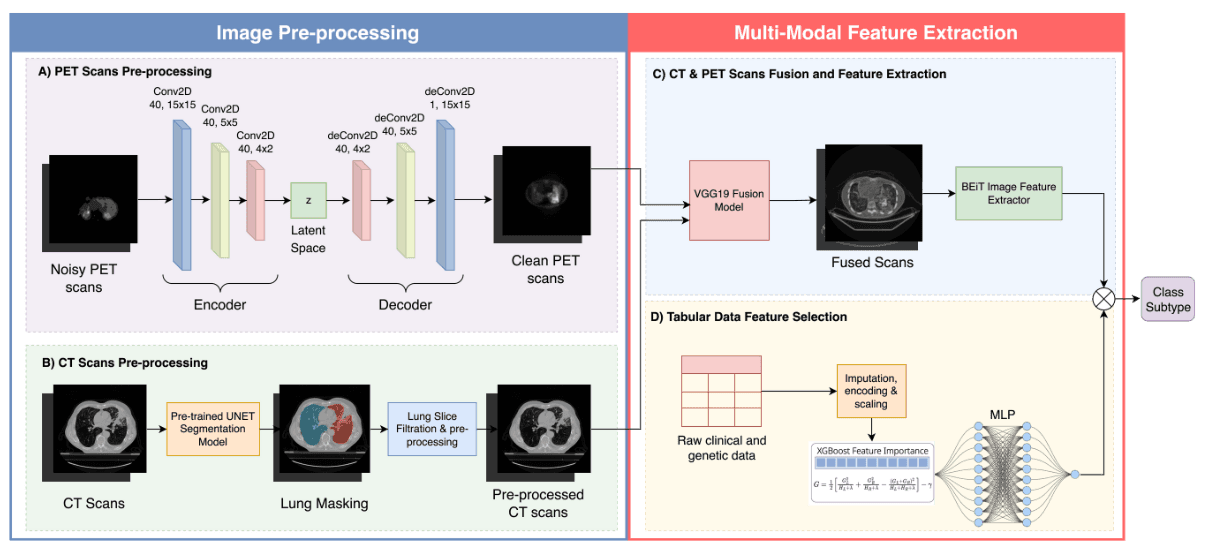
Denoising with Deep CNN Auto-Encoders: A key contribution is using deep CNN auto-encoders to denoise PET scans, producing clearer images and improving diagnostic precision. This application of deep learning for denoising sets a new standard in the clarity and usability of medical images.
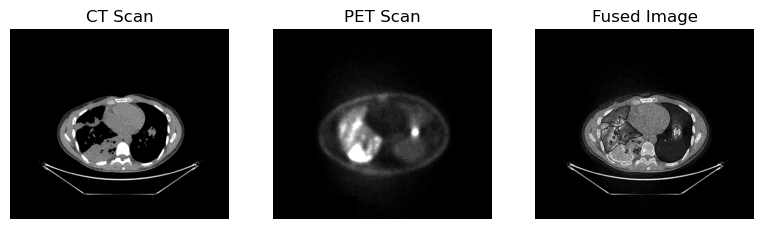
Advanced Image Fusion: The fusion of CT and PET scans uses wavelet decomposition to integrate structural and functional imaging, providing a dual perspective essential for detecting and characterizing cancerous tissues. This fused image overcomes the limitations of single-modality imaging by precisely localizing abnormal metabolic activity.
Application of State-of-the-Art Models: The paper demonstrates the application of two advanced models—MedClip and BEiT (Bidirectional Encoder Representation from Image Transformers)—which are optimized for high-resolution medical image analysis. This novel use of transformer-based architectures represents a breakthrough in NSCLC classification.
AI Implementation in NSCLC Classification
The AI-driven model architecture in this paper leverages a combination of deep learning and transformer-based models:
MedClip: A dual-encoder architecture that aligns medical images with clinical and genomic data using contrastive learning. This innovative model provides comprehensive insights by capturing complementary information from the fusion of multimodal data.
BEiT (Bidirectional Encoder Representation from Image Transformers): Based on transformer architecture, BEiT handles medical imaging tasks using masked image modeling and bidirectional context understanding. The model is particularly effective in analyzing fused images, allowing it to capture complex dependencies and improve classification accuracy.
Deep CNN Auto-Encoders: Used to denoise PET scans before fusion with CT scans, this approach significantly enhances image quality, helping the models focus on critical regions of interest.
Methodology
1. Comprehensive Pre-Processing
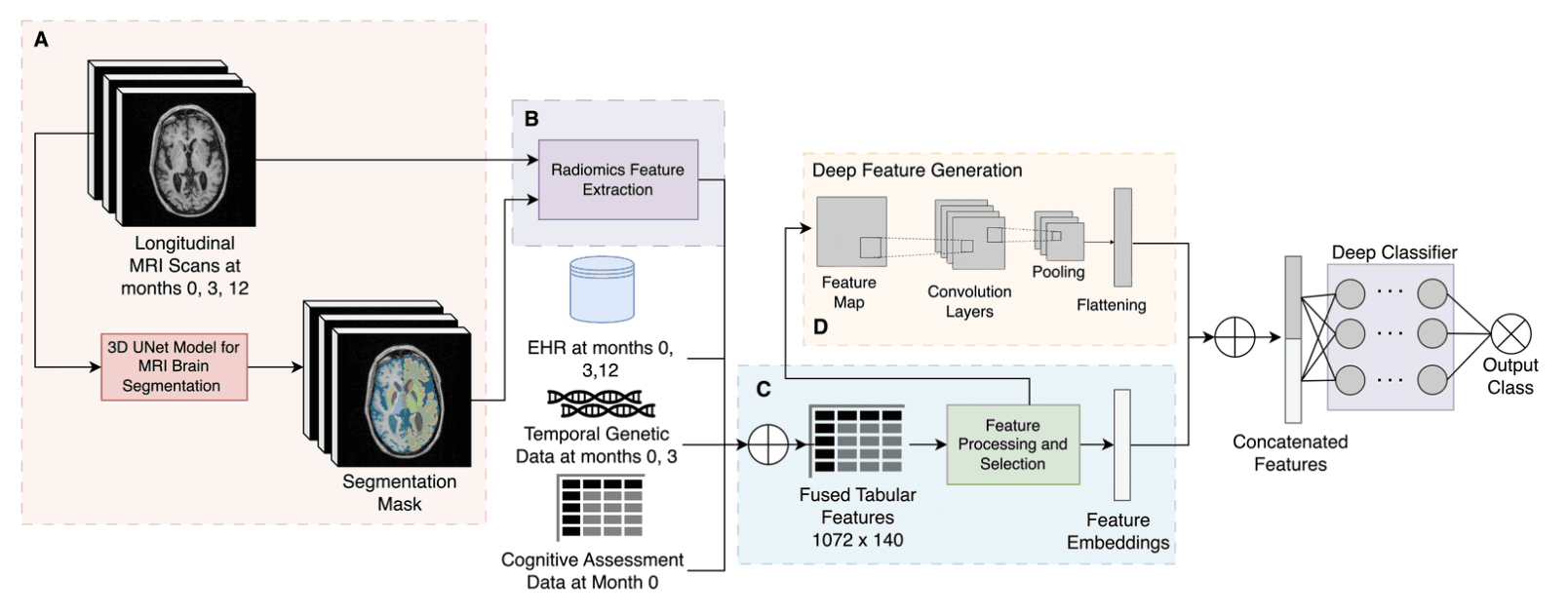
Imaging Data: PET scans undergo denoising using CNN auto-encoders, while CT scans are enhanced through normalization and contrast adjustments. 3D Slicer ensures accurate image registration between CT and PET scans.
Clinical and Genetic Data: Rigorous pre-processing steps for tabular data include missing value imputation, class balancing using SMOTE, and feature importance ranking through XGBoost.
2. Image Fusion Process
The fusion of CT and PET scans is performed using wavelet decomposition. CT scans provide detailed anatomical information, while PET scans offer insights into metabolic activity. This fusion creates a dual-modality image that highlights tumor regions more effectively:
Wavelet Decomposition: The images are decomposed into four coefficients (LL1, LH1, LV1, and LD1), and the inverse wavelet transform reconstructs the fused image, which retains both structural and metabolic features.
3. Baseline Models
Several baseline models, including SVM, logistic regression, and various CNN architectures, were tested:
2D CNN and 3D CNN: These architectures were applied to CT and fused images, providing a benchmark for the effectiveness of multimodal integration.
VGG16, ResNet, Inception, and Xception: These advanced CNN architectures were evaluated on single-modality and fused images to showcase the advantage of image fusion.
4. Multi-Modal Classification
MedClip: This model employs a dual-encoder structure to integrate visual and textual data (e.g., clinical records), aligning them in a unified feature space.
BEiT: Using masked image modeling and bidirectional context modeling, BEiT develops robust representations from images, particularly excelling in multi-modal tasks. It was tested on three combinations of image inputs: CT alone, separate CT/PET, and fused CT/PET images.
5. Datasets
The research uses three datasets:
NSCLC Radiogenomic Collection: Comprising over 285,000 scans of 211 patients, this dataset includes both CT and PET images and genomic data.
NSCLC Radiomics Dataset: Used to augment training data, this dataset consists of 422 patients’ images.
Large-Scale CT and PET Dataset: Used to train the auto-encoder for PET scan denoising, improving image quality.
6. Model Training
The models were trained with:
Hyperparameters: A learning rate of 0.001, batch size of 96, and dropout rate of 0.5 were maintained for deep learning models.
Optimization: XGBoost was used for feature selection in tabular data, while GridSearch was applied for parameter tuning in traditional machine-learning models.
Cross-Validation: A 5-fold cross-validation method was implemented to ensure robustness in the evaluation process.
7. Evaluation Metrics
The models were evaluated using:
Accuracy, Precision, Recall, and F1-Score: These metrics provide a comprehensive understanding of model performance in a medical context, focusing on the F1-score for its balance between precision and recall.
Results and Discussion
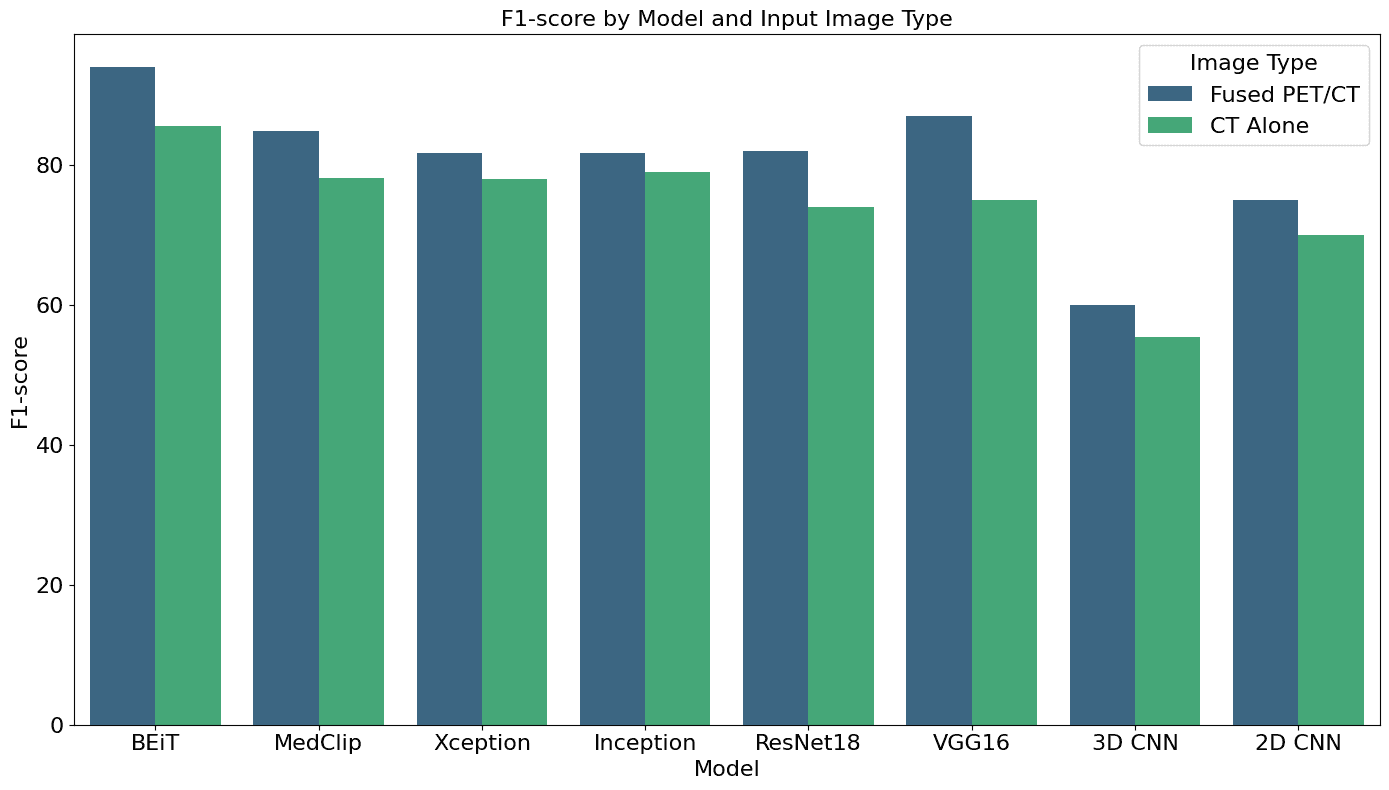
Quantitative Analysis: The BEiT model outperformed other models, achieving a classification accuracy of 94.04% on fused CT/PET images. This significantly improves over single-modality models (e.g., CT alone).
Multi-Modal Performance: Fused CT and PET images boosted model performance across all metrics, demonstrating the value of multi-modal integration for NSCLC diagnosis.
Transformer-Based Models: The use of BEiT showed a distinct advantage in handling the complexity of fused imaging data, providing superior performance compared to traditional CNNs.
Conclusion
This paper presents a significant advancement in NSCLC diagnostics by integrating multimodal data (CT, PET, clinical, and genomic). The key contributions include:
Advanced Image Fusion: Combining structural and metabolic imaging provides a comprehensive view, enabling more accurate tumor detection.
Transformer-Based Architectures: The use of MedClip and BEiT sets a new standard for handling high-dimensional, multi-modal medical data.
The findings highlight the potential of fusing multimodal data to improve cancer diagnosis, and the paper establishes a new benchmark in NSCLC classification with an accuracy of 94.04%.